Posted in politics, Topical Statistics

First post-election analysis

The aftermath of the General Election has led to much discussion about the reliability of the pre-election polls.

One thing that is yet unknown is the potential influence the opinion polls themselves had on how people voted in relatively close contests. Were potential UKIP voters more likely to stick with Conservative candidates in constituencies that could turn Labour? How much did the “fear of SNP” holding the balance of power affect previous Liberal Democrat voters in England? Who stayed away from polls: could this have dramatically have influenced the weightings that should have been given in pre-election polling?

Having sourced results data from the BBC website [by constituency, based on AP reporting of results] and also electorate sizes from the AP website I decided to look at aspects of election voting that have not (as yet) been widely discussed. There are still some minor issues with the data – where the turnout (as reported by the BBC) is not the same as that based on AP figures for the electorate size (9 constituencies in total).

I have decided to put the mapping data to one side at the moment – lots of maps (of both winners and runners-up) abound at the moment, and detailed spatial analysis will wait until I confirm the data about electorate sizes.
TurnoutByRegion

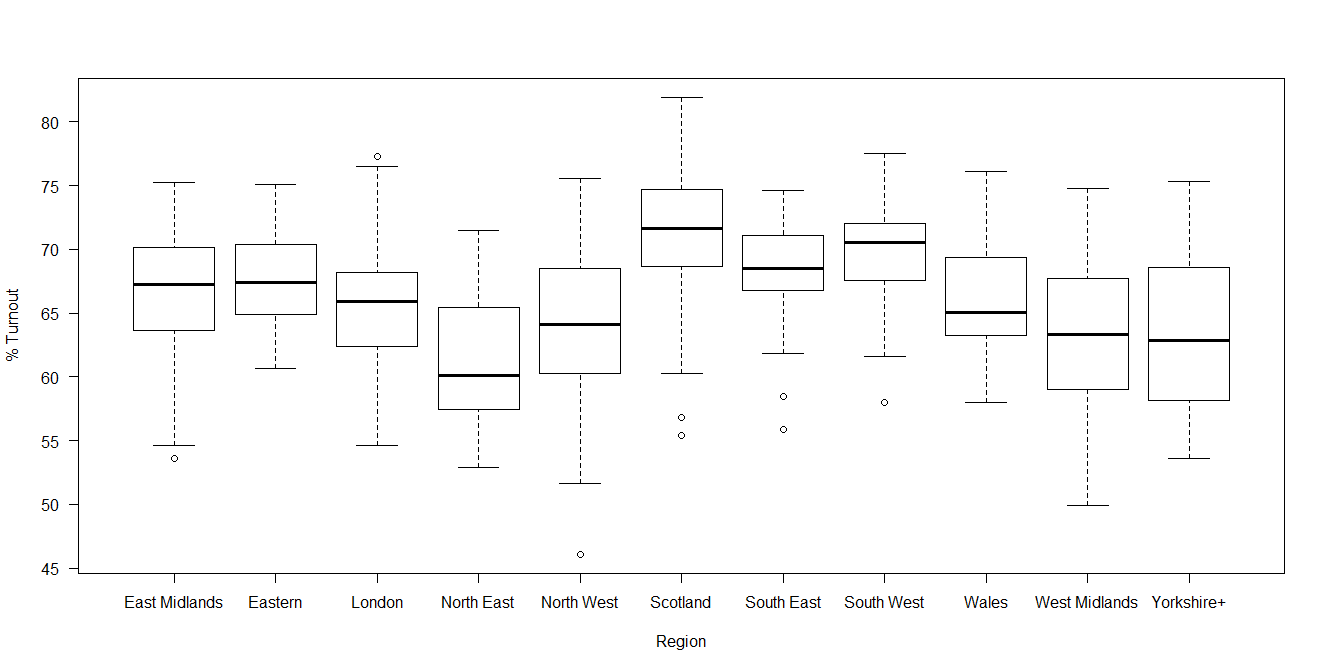
Turnout in Scotland did indicate that in the post-referendum climate, increased voter engagement and participation has continued. Compare the graph above with that of 2010 and the difference in Scottish engagement is evident.

TurnoutByRegion2010

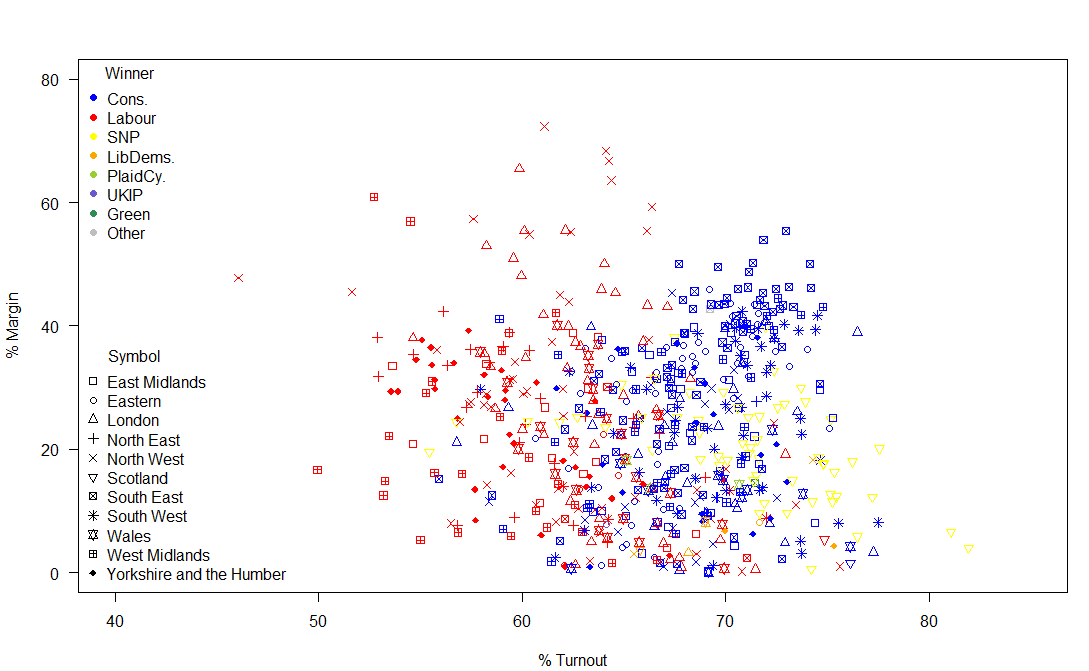
Now looking at the margins of victory – by region and by victor.
TurnoutMarginRegionWinner

So, what is striking about this image? Some Labour MPs had a huge margin of victory. Really a margin of victory of greater than 20% of voters is inefficient distribution of votes. Otherwise, the main talking points are the high turnout in many Scottish constituencies and the fact that the SNPs didn’t have the complete landslide of votes that their return of seats (almost 95% of Scottish seats) suggested and also that there was a much higher turnout in Conservative seats than in Labour seats.

Of the 2,909,882 valid votes cast in Scotland, the SNP polled 1,454,439 (49.98%), with Labour on 24.06%; 15.16% for the Conservatives and 7.55% for the Liberal Democrats. However, due to the First Past the Post system, the return on votes for the SNP resulted in them winning all but 3 of the 59 Scottish seats.

In Wales: Conservatives 27.25% [11 out of 40 (27.5%) seats]; Labour 36.86% [25 (62.5%) of seats]; UKIP 13.63% [0 seats]; Liberal Democrats 6.52% [1 seat]; Plaid Cymru 12.12% [3 (7.5%) of seats].

Wales is therefore a prime example of how UKIP failed spectacularly in converting votes into seats.

Before the election, there was speculation about how the UKIP vote would affect the main parties. UKIP did poll relatively well in “safe” Conservative seats – building their vote share with no direct return.   The effect on the Labour vote was more direct – UKIP polled slightly better in areas that could have been marginal Labour victories [in the 15000-20000 Labour votes; the Conservatives won 61 seats, Labour won 91 seats, the Liberal Democrats 1 seat and the SNP won 18 seats] than they did in the equivalent Conservative seats. Therefore, UKIP voters had more of an influence in potential Labour gains over Conservatives than was perhaps expected.

ConsVUKIP

LabourVUKIP

Other than the unfortunate problem of lack of proportionality created by FPTP voting, another issue is caused by the discrepancy in the sizes of the electorate. Welsh constituencies, in particular, are unusually small and may be subject to boundary changes in the future: the very small Scottish constituencies are islands which don’t lend themselves to easy mergers with parts of the mainland.
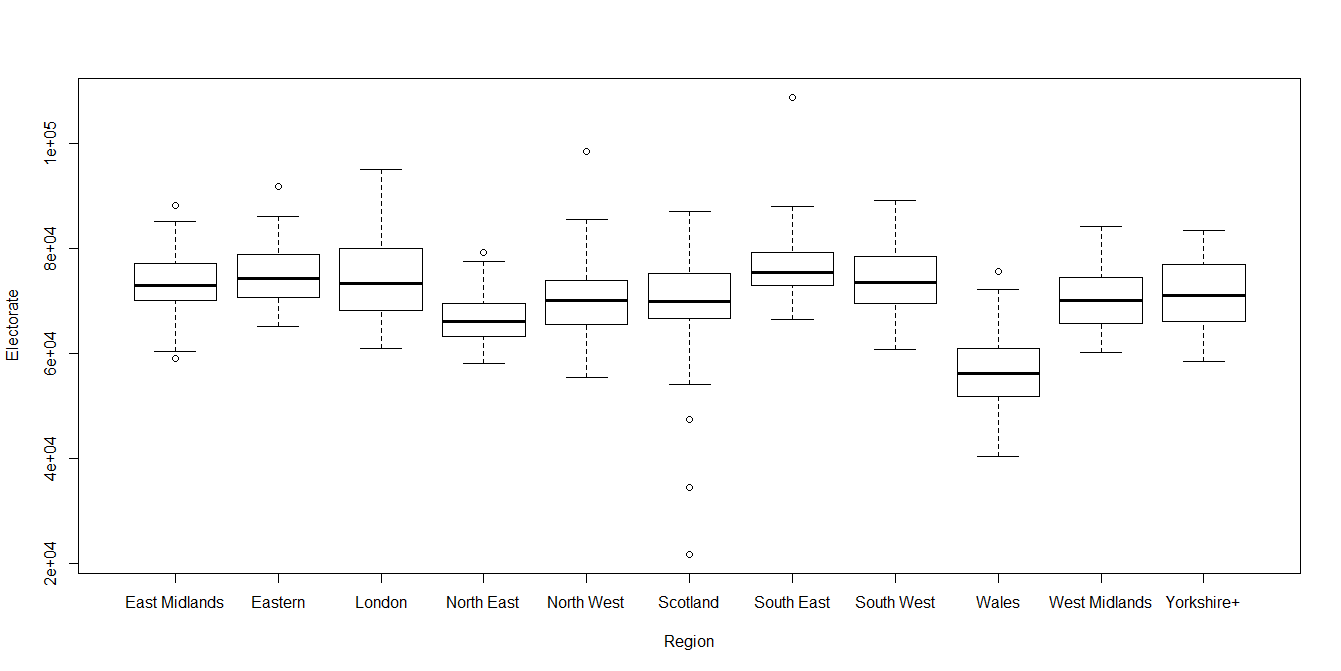
ElectorateByRegion

All discussions about changing the electoral system should first consider fixing the current system: the size of the constituencies is too variable to be considered equitable.

Thus the size of the margin matters in terms of the number of potential (not just actual) voters.
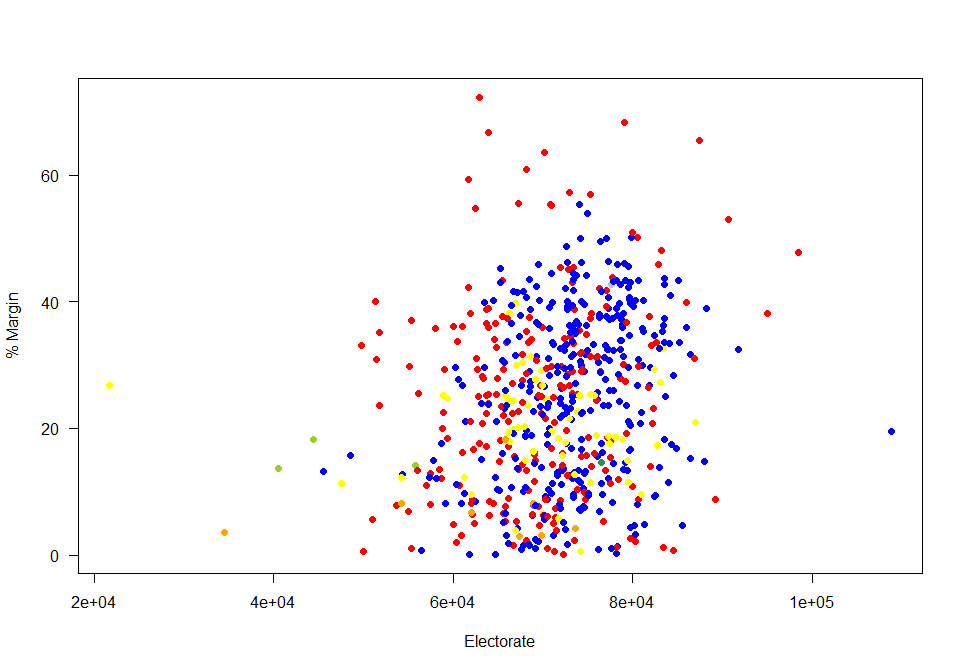
PercentMarginElectorate

So who had “important” votes?   Those in the bottom left of this graph: relatively small electorates in close contests. The two extremes (left and right) of this graph represent island constituencies [Na h-Eileanan an Iar is the smallest constituency, while the Isle of Wight is the largest constituency].

Looking at the constituencies where the margin of victory was less than 5% of those who voted by the size of the constituencies. Four out of the Liberal Democrats eight seats were on margins of less than 5% of valid votes. Turnout in these close seats were (on average) higher than in the seats with a closer margin: so a close race does help to encourage turnout. A “safe seat” is not a helpful thing for voter engagement.

TurnoutElectorateTight

2015
Cons. Green La

bour

LibDems. PlaidCy. SNP UKIP Speaker
2010 Cons. 295 0 10 0 0 0 1 0
Green 0 1 0 0 0 0 0 0
Labour 9 0 209 0 0 40 0 0
LibDems. 27 0 12 8 0 10 0 0
PlaidCy. 0 0 0 0 3 0 0 0
SNP 0 0 0 0 0 6 0 0
UKIP 0 0 0 0 0 0 0 0
Speaker 0 0 0 0 0 0 0 1

The main unexpected outcome of the election was not the collapse of the Liberal Democrat vote but the extent to which Liberal Democrat seats were won by Conservative rather than Labour votes. However, this should not have been surprising, as 38 of the Liberal Democrats had a Conservative runner up in 2010. But only 17 Liberal Democrat seats had a Labour runner up in 2010.

Runner Up 2010
Winner 2010 Cons. Labour LibDems. PlaidCy. SNP Other
Cons. 0 137 167 0 0 2
Green 0 1 0 0 0 0
Labour 147 0 76 5 28 2
LibDems. 38 17 0 1 1 0
PlaidCy. 1 2 0 0 0 0
SNP 4 2 0 0 0 0
Speaker 0 0 0 0 0 1

Only 109 out of 632 GB seats changed parties this election. These swing seats were mainly Liberal Democrat to Conservative (27) and Labour to SNP (40). Conservatives retained 295 of their 306 2010 seats; gaining 36 from Liberal Democrats and Labour. Labour retained only 209 of their 258 2010 seats; the SNP gained 50 seats from Labour and the Lib Dems. The SNP gains were particularly noticeable as they had come second in 29 constituencies in 2010 (having won 6). In 21 of their seats that they won this time round, the SNP came from at best a third place in 2010.

So – what have we learned from all of this. The election results were far messier than many had anticipated. There is a lot of analysis to be done and all of the soul-searching about the appropriateness and efficacy of opinion polls will no doubt be of interest to many statisticians. As no preferences are expressed under the FPTP system we will never really know the extent of tactical voting in UK elections.

Posted in politics

Final (Election) Countdown

A quick peak at how marginal the different seats were in the 2010 election.

Election majority (2010 general election)

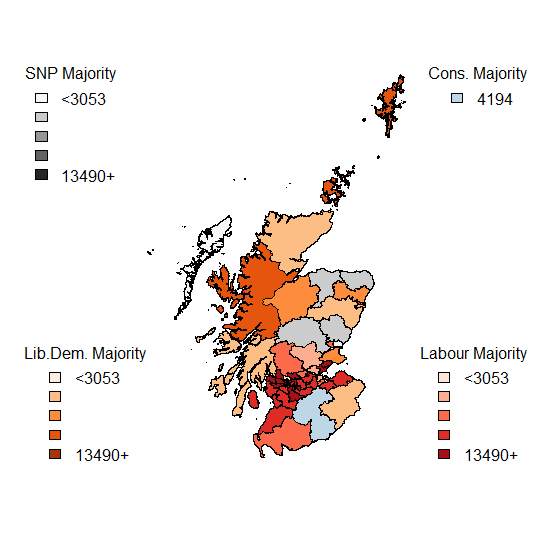
To interpret this map: the darker the colour, the greater the majority.  I’ve looked at the 3 major (2010 general election) parties in this map.  Still working on a better colour scheme for screens; if current polls are correct, I’ll need another colour for the Scottish National Party, and at the moment it is difficult to distinguish between some of the reds [Labour] and oranges [Liberal Democrats].

Considering that Labour won 258 seats in 2010, some may find the relative lack of red on the map surprising.  This illustrates one of the problems of mapping constituencies that are really different sizes due to population density disparities.  Therefore, looking at the NUTS1 regions allows more detailed map to be used.

London, Scotland and the SouthWest are used as illustrating examples of looking at things at NUTS1 level.

London Majority in 2010

London demonstrates some obvious spatial patterns – inner and outer London didn’t vote in the same way in 2010 – will this change this year? If so, will demographic changes have influenced any changes? Or would socio-economic factors be a bigger driver of change in voting behaviour?

South West Majorities (2010)

So, a major difference between London and the South West is the lack of Labour seats… but also the lack of dark shades – there are many more “closer” seats in the South West than in London – the colours on this map will definitely change on Friday!  Also, the odd shaped constituency near the top of the map is Bristol North West – some of the boundary is in the Bristol Channel – due to the strange shape of Avonmouth!

Scotland majorities (2010)

The Tories only won a single seat in Scotland… so really there was no need to show an actual scale for them.  The SNP are expected to dramatically change this map too!

So, work to do before Friday: better colour scheme – I’ll have to go away from colours that are related to the traditional colours.

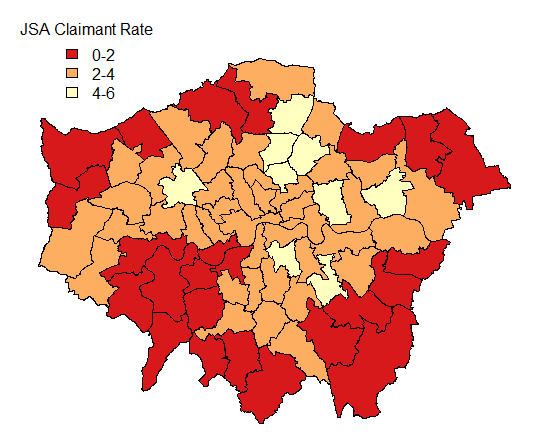
Also, I need to sort out the socio-demographics (based on Census data) for the constituencies and ecomonic factors – which will be limited by the data that is available on a constituency level [for example JSA claimant count records the number of people claiming Jobseekers Allowance (JSA) and National Insurance credits, which is not an official measure of unemployment, but is the only indicative statistic
available for areas smaller than Local Authorities.]

I’m not sure how much use the readily available data will be when it comes to explaining the regional variations (especially the differences between 2010), but it will be a busy weekend of analysis.

London JSA rates (March 2015, not seasonally adjusted)

A note: the constituency with the highest JSA [and those claiming National Insurance credits] claimant rate is Birmingham Ladywood  – with an estimated rate of 14.6% of economically active residents.  The next highest is also in Birmingham (Hodge Hill) with the JSA* rate estimated at 9.7%

Posted in politics

Politicians and the (mis)use of statistics

“We need to reward politicians who give us better data and we need to persecute those who dare to use slight-of-hand and mislead us.”

In his piece on Newsnight on Wednesday night (4th February) Ben Goldacre discussed the need for evidence-based decision marking, especially in the political arena – and how democracy needs evidence, not just principles and ideas. This raised a number of interesting concepts that may not have been fully considered at this stage: including the punishment of politicians who misuse statistics and encouraging politicians to create better evidence of what works and what fails.

“Without good quality evidence we are all flying in the dark”

One idea mooted to create better evidence of what works and what fails is to perform randomised trials of policies.

When introducing any new policies, we could randomly split people into two groups – one group for whom the new policy would apply, the other group would remain with the status quo. There would need to be clear measures of success in place before the changes were made. This would be a definite improvement on the state how policy changes are evaluated.

However, with any trials involving people, we, as researchers, need to get ethical approval. Who would provide ethical approval for this? People participating in studies also need to give informed consent and have the ability to withdraw from a study. In terms of implementing unpopular policy changes this would make finding people to willingly participate in these randomised studies of policy efficacy would be extremely difficult.  Should we be willing to bend the standard ethical framework for research in order to measure the efficacy of policies?

In 2013 Iain Duncan Smith (the Secretary of State for Work and Pension) wrongly claimed that official government statistics showed that the coalitions’ benefits cap had got 8000 extra people back into work – briefing journalists secretly before the official data publications. The UK Statistics Authority pointed out exactly how this claim was incorrect “in luxurious detail” (Andrew Dilnot’s official letter to Iain Duncan Smith is here) – that being the extent of the reprimand.

So, how should we appropriately reprimand politicians and others in power how misuse statistics? As opposed to the vicious punishment proposed by Ben Goldacre, I would counter that perhaps additional lessons in the use of statistics would be more appropriate. My, slightly ad-hoc punishment and re-education scheme would be something along these lines:

  • 1st Offence: A two hour seminar (or equivalent) with an online test afterwards
  • 2nd Offence: A full day course (or equivalent in the number of hours) with an online test with the results of the test published online.
  • 3rd Offence: The equivalent of a level one course in statistics (not one aimed at UG mathematics or statistics) with a subsequent essay on why they were wrong (in each of the previous offences) that is published online for public comment which would be graded (pass or fail) by statisticians from the UK statistics authority.
  • 4th (and subsequent) Offence(s): Fines – they’ve had their chances; these fines would go towards the funding of the courses for the previous three offences.

These punishment / rehabilitation schemes for misusers of statistics would, of course, be open to refinement and updating as needs be. People would be referred into the scheme for re-education (although some people may consider it to be a punishment) by the UK statistics authority. Those referred into the system would need to repeat attendance at courses until they pass the tests.

Posted in Topical Statistics

A window of opportunity?

The study by UCL researchers published this week http://onlinelibrary.wiley.com/doi/10.1111/ecoj.12181/full was interesting in its approach… looking at a 10 year window (2001 – 2011); specifically “Over the period from 2001 to 2011, European immigrants from the EU-15 countries contributed 64% more in taxes than they received in benefits. Immigrants from the Central and East European ‘accession’ countries (the ‘A10’) contributed 12% more than they received.”

A major issue with this timeframe is that we cannot consider the conditions for the A10 countries to be approximately constant in terms of ease-of-access to the UK jobs market. The scale of the difference in the numbers of immigrants from the A10 is noteworthy: in 2001 it was 20,735, in 2005 this was 228,030 and in 2011 it was 892,984. The window really matters. Furthermore, in some of the analysis within the paper they look at the window 1995 – 2011. This inconsistency in the timeframes chosen does not lead to full confidence in the results. Just how reliant are the findings on the windows chosen? The robustness measures used within the paper do nothing to check this. The period before the A10 countries joined the EU was one in which the UK performed well economically; since then the economic crisis has hit. While the research supports the conclusions that even in the downturn the EU migrants still out-contributed others, whether that contribution was sufficient to be a net positive depends on the window used.

Many longitudinal analyses are weak in this aspect. A good robustness test will check to see how much of a difference a slight change in the time window selected would have on the overall conclusions as it prevents the criticism of cherry-picking of timeframes to suit a pre-determined outcome.

Posted in Topical Statistics

Consequences

Having been landed with a rather large extra bill for the cost of E.U. membership of £1.7 billion [or about £27 per UK resident] due on the 1st December, the consequences of changes in statistical methodology are prominent in the news.

The UK’s Office for National Statistics submits figures used to calculate the Gross National Income to Eurostat. These figures were agreed; they upwardly revised the estimate of the GNI. This upwards revision in the GNI is directly associated with the upwards revision in the bill.  A guide to what general areas were under revision is here.

One interesting element that added to the upwards figure was the addition of illegal activities into the accounts. Included in this aspect was a calculation of £5.3 billion accounted for by prostitution. The breakdown of this figure is explained well by Jolyon here:  [note that this was published well before the current payment demand was made public and it also links to a commentary about how the Irish Central Statistics Office approached the same problem.]… basically, it boils down to estimates being based on a biased rather than representative sample and no-one really stopping to think about what the total figure would mean.

The surprise shown by politicians about the state of affairs shows as obvious the lack of consideration given to the consequences of changes in statistical methodology. What can seem like minor adjustments can have major consequences.

Posted in politics

Did the Tories kick themselves in the foot by opposing AV?

In a discussion with my parents and brother [three countries, two continents – the wonders of modern communications] over the weekend, we discussed how active Irish voters can be about expressing who they don’t want to be elected. My “home” constituency in Ireland was Dublin South West, which recently had a by-election. This is traditionally a left wing seat, but the transfer patterns were very interesting.

Ireland has a somewhat complicated voting system – Proportional Representation by Single Transferable Vote with multi-seat constituencies. However, in a by-election with only a single seat up for election, this becomes equivalent to the Alternative Vote system that was rejected by the UK electorate in 2011. The first count:

Party Candidate Count 1
Sinn Féin Cathal King 7,288
Anti-Austerity Alliance Paul Murphy 6,540
Independent Ronan McMahon 2,142
Fine Gael Cáit Keane 2,110
Labour Party Pamela Kearns 2,043
Fianna Fáil John Lahart 2,077
Independent Declan Burke 681
People Before Profit Nicky Coules 530
Green Party Francis Noel Duffy 447
Independent Tony Rochford 92
Independent Colm O’Keeffe 74

Under the First Past the Post system, Cathal King would have been elected with just over 30% of the votes cast [note that this was on a turnout of just under 35%]. Under the Irish system, the fun and games are just starting. O’Keeffe is immediately eliminated as he has the fewest votes. Tony Rochford is also eliminated as the sum of his votes and O’Keeffe’s votes [so if all of O’Keeffe’s second preferences transferred to him] is still less than Duffy’s first count total. However if 92+74 = 166 votes were added to Duffy’s total this would exceed Coules’ total, so Duffy cannot be eliminated on the first round. This proceeds for the next few rounds with the candidate with the fewest votes being eliminated each time.

The Irish political landscape is complex, with some artificial boundaries in place due to historic ties to civil war era politics. Fianna Fáil was traditionally seen as left of centre economically, but right of centre socially; whereas Fine Gael was traditionally seen as right of centre economically, but left of centre socially (in terms of being not as linked to the Catholic Church as Fianna Fáil were). Labour is left of centre both economically and socially; Sinn Féin is on the hard left; as are the Anti-Austerity Alliance and many of the independent candidates. At present, there Fine Gael would be seen as the most right-wing of political parties active in Irish politics, but in most other countries they would be considered a centrist party.

Why is the centre so cluttered in Irish politics? The transfer market… to win seats in Ireland you need to be able to convince people who would not give you their first preference to at least give you a preference vote further down their list.  This discourages extreme views as they are not transfer friendly.

In this case, McMahon (Independent) marketed himself as a pro-business candidate, so was considered moderately right-of-centre.

Party Candidate Count 2 Count 3 Count 4 Count 5
Sinn Féin King 7,304 7,340 7,448 7,580
Anti-Austerity Alliance Murphy 6,579 6,622 6,890 7,079
Independent McMahon 2,167 2,227 2,265 2,464
Fine Gael Keane 2,117 2,194 2,203 2,267
Labour Party Kearns 2,053 2,155 2,170 2,239
Fianna Fáil Lahart 2,085 2,138 2,152 2,200
Independent Burke 711 746 818
People Before Profit Coules 540 554
Green Party Duffy 453

Things then begin to get interesting in the context of Irish politics.

Party Candidate Count 5 Count 6 Count 7 Count 8
Sinn Féin Cathal King 7,580 7,828 8,017 8,999
Anti-Austerity Alliance Paul Murphy 7,079 7,436 7,726 9,565
Independent Ronan McMahon 2,464 3,049 3,416
Fine Gael Cáit Keane 2,267 2,575 3,857
Labour Party Pamela Kearns 2,239 2,492
Fianna Fáil John Lahart 2,200

Traditionally, it would have been quite rare for Fianna Fáil votes to transfer to Fine Gael. Of Lahart’s 2,200 votes, 1,751 expressed further preferences. If we examine the pattern of transfers:

John Lahart’s (Fianna Fáil) transfers went in the following manner: Anti-Austerity Alliance 357; Sinn Féin 248; Independent 585; Fine Gael 308 and Labour 253. So the majority of Lahart’s votes went right-of-centre; followed by the party that nationally is perhaps in least direct competition for votes with Fianna Fáil.  National opinion polls indicate that currently Sinn Féin is second to Fine Gael in popularity. However, there is still a post-troubles stigma attached to the Sinn Féin vote, so they aren’t viewed by many as “just another party”. Therefore, despite some policies being very similar, voters are actively shying away from transferring to Sinn Féin.

In the next round, Kearns (Labour) was eliminated. Almost all of her votes were transferred to Keane (Fine Gael). As these two parties are in coalition government, this transfer pattern is not that surprising, although perhaps surprisingly this means that Labour voters were going towards the right rather than the left wing.

Between them Cáit Keane (Fine Gael) and Ronan McMahon (Independent – but right-of-centre) had a total of 7,273 possible votes to transfer however only 2,821 votes were actually transferred. This reflected that the remaining candidates were substantially to the left of the eliminated candidates, so those un-transferred votes expressed a preference of “none of the remaining candidates”. However, these 2,821 votes split in the ratio of 65% to Murphy of the Anti-Austerity Alliance, 35% to Cathal King of Sinn Féin.

Despite receiving more first preference ballots than any other candidate, King lost out in every other count to Murphy – a pattern indicating that anyone else was preferred, even if their political views could be considered even more incompatible.

So, how does this reflect back to the Tories and AV? If AV was in-situ in the UK, the Tories would not be so concerned about the UKIP vote. UKIP candidates would likely need to get over 40% of the first preference votes to be elected. However, in many more constituencies, the Conservatives would be far more “transfer friendly” than UKIP – with people choosing the option of “anyone but…”

Unless the Irish electorate are far more sophisticated than others, the ability to vote against a candidate by expressing preferences for everyone else would have had some very interesting consequences in the political dynamics at the next UK general election. Instead we are left with the boring first past the post system.

Posted in Topical Statistics

Scottish Referendum results

I’ve been looking at the results in the Scottish independence referendum.  The results will be the basis of a final year project, so further results will follow.

How each local authority area contributed to the overall NO majority
No majority (% of valid ballots counted) in each local authority area

One possible trend that I wanted to look at was how the pattern of inhabitants [based on 2011 Census] of the local authority areas was related to these voting patterns…

What percentage of people were born in England (based on 2011 Census).
A question asked in 2011 Census asked about identity.  This map looks at the proportions in each Local Authority who claimed "Scottish" as their only identity.
A question asked in 2011 Census asked about identity. This map looks at the proportions in each Local Authority who claimed “Scottish” as their only identity.