Posted in Eurovision, silly season, Uncategorized

Eurovision 2016: Was Australia Robbed?

Another old Eurovision piece being resurrected for the week that is in it. This one was written with Ben Derrick (my PhD student) and submitted to the Young Statisticians Writing Competition for Significance Magazine (which is jointly published by the Royal Statistical Society and the American Statistical Association). This was our submission.

Every year, the RSS run this competition for early career statisticians to write something for the magazine, more information about this competition can be found here.
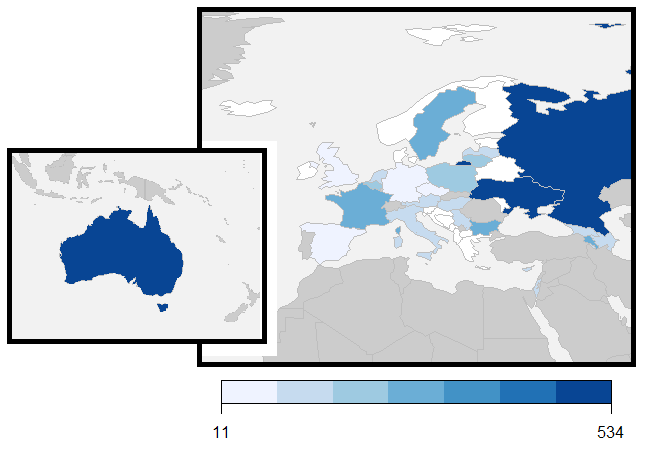
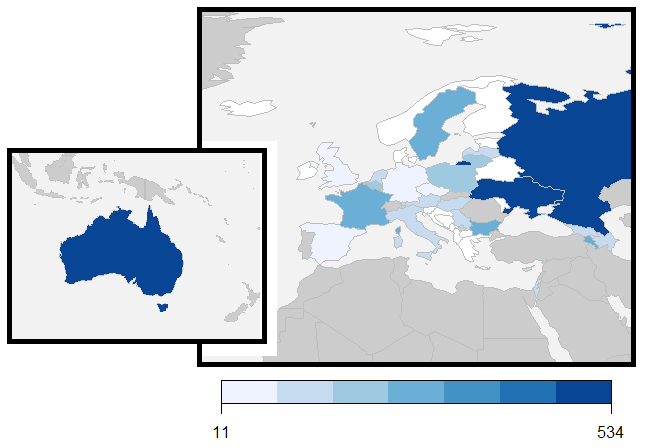
Eurovision2016_finalscores

Figure 1: Final Points Won, Eurovision Song Contest 2016 (Australia not to scale)

Eurovision: the drama, the excitement, the statistics. After an engaging climax to the reveal of the votes, the 2016 Eurovision Song Contest in Stockholm was won by Ukraine, with Australia finishing in second place. During the final on May 14th, Eurovision host Petra Mede stated that nothing has changed in the way you vote, it is simply the way they are presented that has changed. What Petra neglected to mention is that the way the winner is calculated has changed.

The organisers introduced a new voting system hoping that it would lead to a more exciting end to the night [1]. The process of revealing the results was tense, but the results were different to what they would have been under the old system.

There were twenty-six finalists of the 2016 Eurovision Song Contest. A total of forty-two countries participated in the voting process. Each country may not vote for itself. Points are allocated 1 – 8, 10 and 12. Each participating country has a televote and a jury vote; equally weighted.

The calculation underpinning the voting system has evolved over time. In the old system used from 2009-2015, these were combined prior to votes being cast; meaning that each country could give points to ten other countries; the televotes were used to break any ties in ranks. In the new system, the results of each jury vote were presented – in the form of the points allocated to the ten countries; and then the combined points of the televoting from all forty-two countries were presented from lowest score to highest score. Overall ties in the final positions were broken by first comparing the number of countries that voted for each of the finalists and then comparing the number of countries who awarded twelve points to the tied countries.

In the new system first used in 2016, the votes were not combined, there was no restriction on countries allocating both sets of points to the same ten countries. If there is a disagreement between the ranks given by the jury and the televotes, a country may allocate points to more than ten countries. To illustrate the two systems, consider Albania’s votes in Table 1 [2].

For ease, TV in Table 1 represents Televote and Pts is an abbreviation for Points.

Table 1: Albania's votes
New Method Old Method
To Country Jury Rank TV Rank Jury Pts TV Pts Pts Given Sum of Ranks Pts Given
Australia (AUS) 1 1 12 12 24 2 12
Italy (ITA) 3 2 8 10 18 5 10
Russia (RUS) 4 4 7 7 14 8 8
Bulgaria (BGR) 7 3 4 8 12 10 7
France (FRA) 2 11 10 10 13 6
Ukraine (UKR) 12 5 6 6 17 5
Spain (ESP) 5 23 6 6 19 4
Poland (POL) 14 6 5 5 20 3
United Kingdom (GBR) 6 18 5 5 20 2
Lithuania (LTU) 20 7 4 4 24 1
Sweden (SWE) 11 8 3 3 24 0
Armenia (ARM) 15 9 2 2 25 0
Israel (ISR) 8 17 3 3 25 0
Hungary (HUN) 10 10 1 1 2 27 0
Malta (MLT) 9 16 2 2 28 0
Austria (AUT) 16 13 29
Azerbaijan (AZE) 13 19 32
Germany (DEU) 18 15 33
Cyprus (CYP) 23 12 35
Latvia (LVA) 17 21 38
Belgium (BEL) 25 14 39
Croatia (HVR) 21 20 41
Czech Rep. (CZE) 22 22 44
Serbia (SRB) 19 26 45
The Netherlands (NLD) 24 24 48
Georgia (GEO) 26 25 51

Albania’s jury and public voters were in agreement about their favourite song – the Australian entry. The jury placed France second (giving them 10 points), but the televoters did not give any points to France (because the French song was ranked 11th in the Albanian televoting process). The televoters ranked Ukraine 5th (thus allocating them six points) whereas the jury ranked the same song 12th – assigning them “null points”. Albania gave points to fifteen different countries.

Under the old system, the sum of the ranks assigned are sorted from smallest to biggest, with the order for tied ranks being decided by the song that received more viewer votes. Under this system, Sweden just misses out on receiving a point because Lithuania received more viewer votes in Albania.

Taking this into account, what would have happened if no changes had been made to the presentation of the preferences of the 42 different countries and the same calculation method used last year had been used again?

Table 2 shows that under the old method the winners would be Australia, followed by the Ukraine, with Russia in third place. The major winner under the new system (other than Ukraine of course) is Poland; moving from what would have been nineteenth place under the old system to eighth place under the new system.

Table 2: New (actual) results against Old results
Rank New calculation (2016) Old Rank Old calculation  (2009-2015) Change in Rank
1 Ukraine 534 1 Australia 333 -1
2 Australia 511 2 Ukraine 288 1
3 Russia 491 3 Russia 242 0
4 Bulgaria 307 4 Bulgaria 187 0
5 Sweden 261 5 France 171 -1
6 France 257 6 Sweden 164 1
7 Armenia 249 7 Armenia 146 0
8 Poland 229 8 Lithuania 108 -1
9 Lithuania 200 9 Belgium 95 -1
10 Belgium 181 10 The Netherlands 81 -1
11 The Netherlands 153 11 Latvia 81 -4
12 Malta 153 12 Austria 73 -1
13 Austria 151 13 Italy 70 -3
14 Israel 135 14 Hungary 63 -5
15 Latvia 132 15 Serbia 61 -3
16 Italy 124 16 Georgia 59 -4
17 Azerbaijan 117 17 Azerbaijan 55 0
18 Serbia 115 18 Cyprus 55 -3
19 Hungary 108 19 Poland 49 11
20 Georgia 104 20 Spain 39 -2
21 Cyprus 96 21 United Kingdom 30 -3
22 Spain 77 22 Israel 28 8
23 Croatia 73 23 Malta 24 11
24 United Kingdom 62 24 Croatia 24 1
25 Czech Republic 41 25 Germany 8 -1
26 Germany 11 26 Czech Republic 2 1

The different results between the two methods can be explained by considering the difference between the jury and telephone votes as illustrated by Table 3.

Table 3: Comparison of Jury and Televote points allocation
Televote points Jury Points Difference in Points
Ukraine 323 211 112
Australia 191 320 -129
Russia 361 130 231
Bulgaria 180 127 53
Sweden 139 122 17
France 109 148 -39
Armenia 134 115 19
Poland 222 7 215
Lithuania 96 104 -8
Belgium 51 130 -79
Malta 16 137 -121
The Netherlands 39 114 -75
Austria 120 31 89
Israel 11 124 -113
Latvia 63 69 -6
Italy 34 90 -56
Azerbaijan 73 44 29
Serbia 80 35 45
Hungary 56 52 4
Georgia 24 80 -56
Cyprus 53 43 10
Spain 10 67 -57
Croatia 33 40 -7
United Kingdom 8 54 -46
Czech Republic 0 41 -41
Germany 10 1 9

There is an apparent wide disparity between the total televote points and the total jury points. Poland received 222 of their 229 points from the televote. The poor performance of the United Kingdom in the televote is in line with previous years, but this was more clearly highlighted on the night by the new method of presenting the results.

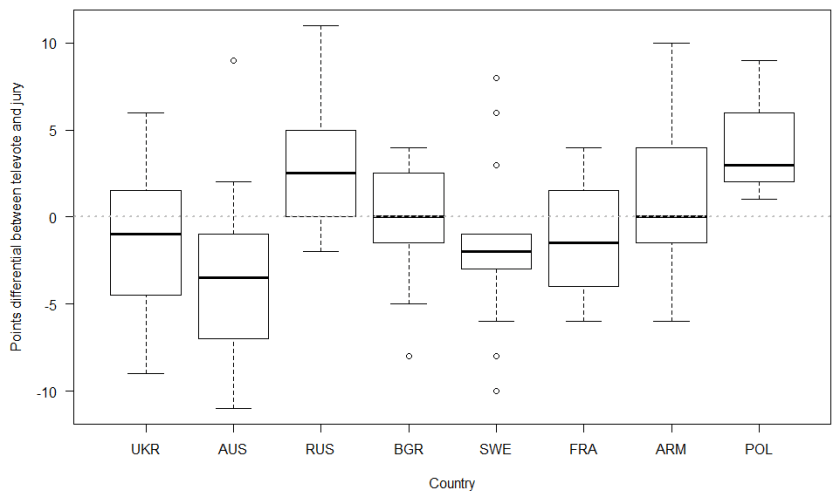
The old calculation method allows an entry that is considered average by both the televote and public vote to receive some points, but an entry that is considered very poor by one or the other would be very unlikely to obtain points. The new calculation method allows an entry that is considered to be amongst the poorest by either the jury or the televote to receive substantial points from the other. The pronounced difference between the points allocated by jury and televotes systems to Poland is highlighted in Figure 2.

Eurovision2016_TelevoteVJuryTop8

Figure 2: Top 8 finishers – ordered by final finishing position.

The Australian entry was a solo female singing a moderate tempo ballad. Traditionally this is considered a safe entry and similar entries have done very well in the past. Under the old method every country except for Montenegro would have awarded Australia some points, Ukraine and Russia would have failed to receive points from 5 countries each.

Most of the juries rated Poland very low, but Poland amassed a large total due to the televote, receiving points from every country as illustrated in Figure 2. Under the old method, the televote and jury vote would have been averaged resulting in a more modest score from each country to Poland.

It is surprising to note that Poland have never won Eurovision. With a strong televote secured due to diaspora across Europe, all Poland has to do is provide a song that will also appease the jury vote, and they will certainly be a favourite for victory under this new system.

If the old calculation method were to be applied to the final, it would also be applied to the semi-finals as well. If different countries were to qualify for the final, this would inevitably impact the final voting. The change in voting system did not affect which countries qualified from the semi-finals on this occasion, although it did make some minor differences in the order. Sorry Ireland (and Westlife) fans – you still would not have qualified!

It is difficult to say whether one calculation method is fairer than the other calculation method. The apparent reason behind the reintroduction of the jury vote for use within the old system was to try and nullify the effect of the diaspora and geographical block televote. However, the new method may not be as effective in achieving this goal.

The new method is more transparent, it is clear to see whether points are coming from the jury or the televote. In addition, a country is guaranteed to be rewarded if it is liked by either. Certainly the new format for the voting resulted in a dramatic finale, therefore the producers are likely to favour this method for future contests.

The choice between the old calculation method and the new calculation method highlights the perils of applying rank based approaches. There are many occasions where a group of judges are asked to rank items, but there is no optimum solution for the combination of their ranks. Rank based approaches do not give an indication of the extent of the difference between any two consecutive ranks. In any event, the ranking applied by each judge or individual is fundamentally subjective.

When assessing whether two distributions are equal, the standard test when the observations are paired is the Wilcoxon Rank Sum test. In this example the observations are paired by country. The results of a test on the distribution of the ranks for the old method compared to the distribution of the ranks for the new system, shows that the two distributions for the two methods do not differ (Z = -1.500, p = 0.134). Similarly, a test comparing the distribution of the points awarded by the televote and the points awarded by the juries, shows that the distributions do not differ (Z = -0.546, p = 0.585).

These results are counter-intuitive to the suggestion that the jury and televote opinions show a wide disparity. Therefore the standard test for comparing equality of distributions is not without scrutiny. The mean (and median) rank from the jury is fixed by design to be equal to the mean (and median) rank of the televote. In addition the mean (and median) number of points awarded by both the jury and the televote is also fixed by design. This highlights that the Wilcoxon Rank Sum test is less powerful when the measure of central location are equal for both groups.

In fact, if the televote were to rank the countries in the complete opposite order to the jury vote, the test statistic would result in a p-value of 1.000. This peculiarity could be detected by also calculating the correlation between the two ranks – complete opposite ranks would have a correlation coefficient of -1.

Even with clear instructions as to how to use the ranking system, problems such as those faced by Denmark’s “Juror B” may arise, where she ranked the countries in reverse order in error [3].

This could have been detected by noting the negative correlation between the ranks given by Juror B and those given by the other four Danish jurors. The juror repeated the same procedural error in both the semi-final voting stage and during the final. A simple check using correlations could have detected the problem after the semi-final and allowed a reminder to be given about the correct procedures, without disclosing ranks given by other jury members.

In the final, if Danish Juror B had specified her ranks correctly then Australia should have received 12 rather than 10 points from the Danish jury, whereas Ukraine would have received 0 points from the Danish jury (rather than 12 points). This would have made the final points tally even closer. Under the old method, Australia’s margin of victory would have increased.

The number 13 may also have proved to be unlucky for Australia, this position in the running order meant they performed in the first half of the contest. Ukraine and Russia both received positions in the second half of the running order. All but 4 winners in the 21st century have appeared in the second half of the contest. In fact, Australia beat Ukraine in their semi-final, in which they both performed in the second half.

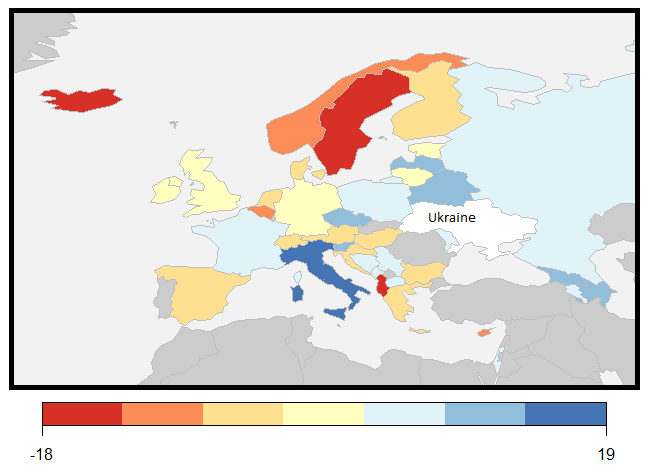
Historically, analyses of the Eurovision song contest voting focus on predominantly geographical voting blocs. Ukraine is part of the established former Soviet bloc. As relative newcomers to the contest and located outside Europe, Australia are not yet part of an established bloc vote. Eastern Europe and Western Europe appear to be divided over which entry was their favourite, see Figure 3.

Eurovision2016_PointsDiffAusVUkr

Figure 3: Points differential between the points awarded to Ukraine over Australia

Countries in the former Soviet bloc and in closest proximity to Ukraine generally gave more points to the entry from Ukraine than that of Australia. The Scandinavian bloc however was much more favourable to Australia than Ukraine. If Juror B had voted correctly Denmark would have been more obviously part of this bloc.

The Ukrainian entry was considered by some commentators to have a political tone with respect to the Russian and Ukrainian dispute over Crimea, possibly explaining why Russia awarded Ukraine a lower proportion of its total points than usual. However, with its clever staging similar to the 2015 winner, Russia was the pre-contest favourite to win. Political reasons may have encouraged many other countries to vote for Ukraine. This in turn may have further contributed to victory being snatched from Australia.

It appears that everything was conspiring against Australia, but is it fair to conclude that Australia was robbed? Aspects transpiring against Australia can be explained as factors that are to be expected in a subjective competition. Australia can claim to be unfortunate being randomly drawn in the first half of the running order. The new calculation method had been made available well in advance of the contest. Ultimately, the countries that rated Ukraine more favourably than Australia may be down to cultural tastes.

References:

[1] http://www.eurovision.tv/page/voting
[2] http://www.eurovision.tv/page/results
[3] http://www.independent.co.uk/arts-entertainment/tv/news/eurovision-2016-jury-member-gives-completely-the-wrong-points-a7032561.html

Posted in Eurovision, silly season, Uncategorized

Eurovision: mapping out the cliques

Inspired by a student project a few years ago, I started investigating the voting patterns of the Eurovision song contest.  Here is something I wrote just after the 2014 Eurovision Song Contest.

Once again, we have just had the fun and games that goes alongside the Eurovision Song Contest.  An institution started in the 1950’s; it has witnessed the effects of much social and political change.

Year on year, commentators note particular voting patterns [Greece and Cyprus exchanging 12 points if both have made it to the finals], becoming increasingly cynical about the nature of the competition. It is of some interest to discover if it is possible to break through these perceived cliques: will a good enough song win the Eurovision, or do some countries have almost no hope?

To provide some supporting evidence of this clique like behaviour, voting records were obtained from the official Eurovision song contest website.  To simplify the analysis presented here, only results from the finals (so excluding semi-finals) will be presented.  As the voting procedure has changed several times in the history of the contest, the years 2009-2013 were selected.  These years all had semi-final contests to decide which countries precede into the final, and scores were allocated based on an equal weighting of viewer telephone votes and a national judging panel.

The Business of Voting

The procedure for allocation votes have changed multiple times since the conception of Eurovision; notably in 1998 when mass televoting was introduced (only countries without a properly functioning telephone network were permitted to retain the jury system) and in 2009 this was changed to give an equal weighting to audience and jury votes. In 1997 a relegation system based on the performance in the previous five years was introduced, to be replaced with a semi-final in 2004.  In 2008 the current system of two semi-finals was introduced.  Throughout all the change in the last twenty years, one thing has remained constant: the votes themselves (1, 2, 3, 4, 5, 6, 8, 10 and 12 points) that can be given to any other country in the final, which was introduced in 1975. [i]

Basic information about the split between televoting and jury decisions are released after the event, but these are not broken down by country.  Due to the changes in the voting regulations, it is of interest to see if any perceived voting alliances persist within the current voting system, other than the traditional exchange (where possible) of twelve points between Greece and Cyprus.

Social Networks

With the pervasiveness of social media online, the concept of a social network has become familiar to many; to clarify here we use the idea that a social network is “a system of social interactions and relationships”.[ii] Social network analysis has become a way for people to explore how connected their networks of facebook friends are; how quickly trending topics spread on twitter and how to track down culpable groups based on the meta data (not the content) of email exchanges amongst many other (some are even useful) usages of the analysis of social networks.

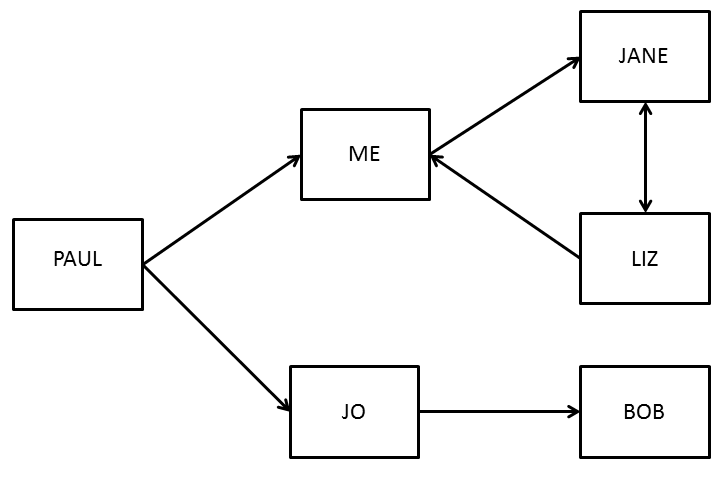
The simplest form of social network is that like a friendship network on facebook, as represented by Figure 1. In this network, I am directly connected to nodes labelled Paul, Jane and Liz.  Nodes Jane and Liz are connected to one another, but not directly connected to node Paul.  Nodes Jo and Bob are indirectly connected to me through Paul.  In this basic setup, the connections between the nodes allow for travel in both directions – as friendship is a shared experience.

BasicSN


Figure 1: Basic social network

Suppose, instead, that this network represented email traffic, the arrows represent who sent the email and who was at the receiving end of emails.

BasicDSN

Figure 2: A directed social network

Figure 2 is of the same basic structure as Figure 1, but this time information only flows in the direction of the arrows.  So Paul sends me and Jo an email. Jo forwards the email onto Bob.  I forward the email to Jane, who enters into an email exchange with Liz who then responses to me.  Without creating additional connections there is no direct path from Bob to Liz at present.  This explains the basic difference between directed and undirected networks.

Finally, before looking at the Eurovision data, we should think about weighted social networks.  You could imagine a weighting being given based on the number of emails exchanged between people in the network. Figure 2 represents a situation where every connection has equal weight, but this will not allow us to represent the difference between one country giving another a single point versus the all-important “douze points”.

BasicWDSN

Figure 3: A weighted, directed social network

In Figure 3, Paul begins the email chain with two emails to me and Jo.  Both Jo and I send on one of those emails (not necessarily the same one) to Bob and Jane respectively.  Jane and Liz then start a mini conversation about the email (Jane sending a total of three emails to Liz, Liz replies twice) and Liz then sends me a summary of their discussion.  This is a basic example of what is called a weighted, directed social network, visualised as a graph.

Available Data

On the Eurovision website information on the voting records in the song contest finals are available from 1957 onwards.  Due to all the changes in the voting process, we will examine the years 2009-2014. Forty-six different countries participated in the song contest in these six competitions; however Andorra and Czech Republic only voted once (in 2009) and have never made it into the final, so they were excluded from subsequent analysis as not containing sufficient information about ongoing voting patterns.  Bulgaria, Latvia and Slovakia voted in five, six and four years, but have never qualified for the final in the years of interest (2009-2014).

Eurovision as a Social Network

Voting behaviour can be represented as a social network; each country has 10 votes to allocate (1, 2, 3, 4, 5, 6, 8, 10 and 12 points) to any other country with a song in the final.  Votes are not always reciprocated. The votes cast in 2014 are shown in Figure 4.  Arrows represent votes cast from one country to another, the shade indicates how strong a vote it is (darker colour being a higher vote, thus low votes are suppressed in this graph for clarity).  All participating countries, even those who did not succeed in reaching the final, get to vote. Thus there are many countries that can cast votes but not receive any votes.

Eurovision2014votesCropped

Figure 4: Representing the votes of 2014 as a social network

To moderate this problem, instead of looking at a single year we look at the average vote received by each of the countries from each of the other countries and model this as a social network.  This is not as simple as adding up the total give from one country to another and dividing by number of years being examined, as we need to divide by the number of times the receiving country made it to the final of the competition in years that the giving country voted.

By examining the voting data in this way, the focus becomes on systematic behaviour rather than the behaviour in a specific year, which may be determined by the individual song.

An average vote of 0 given by country X to country Y indicates that country X never voted for country Y, while and average vote of 12 indicates that country X [Greece for example] always (where possible) gives 12 points to country Y [Cyprus].  This becomes a problem of analysing a weighted (votes have different points), directed (voting is not always reciprocated) network.

The analysis comprised at evaluating how closely connected the different countries were; solely on the basis of their voting history.

 EurovisionClusters

Figure 5: Three cluster solution

The three distinct voting clusters are clearly geographically based – with a clear cluster of former Yugoslavian countries, another under the influence of Russia, with the remaining cluster representing


[i] http://www.eurovision.tv/

[ii] http://www.oed.com/view/Entry/183739?redirectedFrom=social+network#eid139354802


Posted in silly season

Eurovision 2016: Was Australia Robbed?

With all the serious news abound in the aftermath of the EU referendum, we thought that we would examine something less serious in the European context: the ramifications of changes to the voting system in the Eurovision Song Contest.  This piece was originally written as a piece by myself and Ben Derrick for submission to the Young Statisticians’ writing competition in Significance magazine.

EurovisionPic1

Figure 1: Final Points Won in Eurovision Song Contest 2016 (Australia not to scale)

Eurovision: the drama, the excitement, the statistics. After an engaging climax to the reveal of the votes, the 2016 Eurovision Song Contest in Stockholm was won by Ukraine, with Australia finishing in second place. During the final on May 14th, Eurovision host Petra Mede stated that nothing has changed in the way you vote, it is simply the way they are presented that has changed. What Petra neglected to mention is that the way the winner is calculated has changed.

The organisers introduced a new voting system hoping that it would lead to more exciting end to the night [1]. The process of revealing the results was tense, but the results were different to what they would have been under the old system.

There were twenty-six finalists of the 2016 Eurovision Song Contest. A total of forty two countries participated in the voting process. Each country may not vote for itself. Points are allocated 1 – 8, 10 and 12. Each participating country has a televote and a jury vote; equally weighted.

The calculation underpinning the voting system has evolved over time. In the old system used from 2009-2015, these were combined prior to votes being cast; meaning that each country could give votes to ten other countries; the televotes were used to break any ties in ranks. In the new system, the results of each jury vote were presented – in the form of the points allocated to the ten countries; and then the combined votes of the televoting from all forty two countries were presented from lowest score to highest score. Overall ties in the final positions were then broken by first comparing the number of countries that voted for each of the finalists and then comparing the number of countries who awarded twelve points to the tied countries.

In the new system first used in 2016, the votes were not combined, there was no restriction on countries allocating both sets of points to the same ten countries. To illustrate the two systems, consider Albania’s votes in Table 1; they gave votes to fifteen different countries [2].

Albania’s jury and public voters were in agreement about their favourite song – the Australian entry. The jury placed France second (giving them 10 points), but the televoters did not give any points to France (because the French song was ranked 11th in the Albanian televoting process). The televoters ranked Ukraine 5th (thus allocating them six points) whereas the jury ranked the same song 12th – assigning them “null points”. If there is a disagreement between the ranks given by the jury and the phone-votes, a country may now allocate points to more than ten countries.

Table 1: Albania’s votes

New Method Old Method
To Country Jury Rank Televote Rank Jury Points Televote Points Points Given Sum of Ranks Points Given
Australia (AUS) 1 1 12 12 24 2 12
Italy (ITA) 3 2 8 10 18 5 10
Russia (RUS) 4 4 7 7 14 8 8
Bulgaria (BGR) 7 3 4 8 12 10 7
France (FRA) 2 11 10 10 13 6
Ukraine (UKR) 12 5 6 6 17 5
Spain (ESP) 5 23 6 6 19 4
Poland (POL) 14 6 5 5 20 3
United Kingdom (GBR) 6 18 5 5 20 2
Lithuania (LTU) 20 7 4 4 24 1
Sweden (SWE) 11 8 3 3 24 0
Armenia (ARM) 15 9 2 2 25 0
Israel (ISR) 8 17 3 3 25 0
Hungary (HUN) 10 10 1 1 2 27 0
Malta (MLT) 9 16 2 2 28 0
Austria (AUT) 16 13 29
Azerbaijan (AZE) 13 19 32
Germany (DEU) 18 15 33
Cyprus (CYP) 23 12 35
Latvia (LVA) 17 21 38
Belgium (BEL) 25 14 39
Croatia (HVR) 21 20 41
Czech Rep. (CZE) 22 22 44
Serbia (SRB) 19 26 45
The Netherlands (NLD) 24 24 48
Georgia (GEO) 26 25 51

Under the old system, the sum of the ranks assigned are sorted from smallest to biggest, with the order for tied ranks being decided by the song that received more viewer votes. Under this system, Sweden just misses out on receiving a point because Lithuania received more viewer votes in Albania.

Taking this into account, what would have happened if no changes had been made to the presentation of the preferences of the 41 different countries and the same calculation method used last year had been used again?

Table 2 shows that under the old method the winners would be Australia, followed by the Ukraine, with Russia in third place. The major winner under the new system (other than Ukraine of course) is Poland; moving from what would have been nineteenth place under the old system to eighth place under the new system.

Table 2: New (actual) results against Old results

Points Rank
Country New Method (2015) Old Method (2009-2015) New Method (2015) Old Method (2009-2015)
Ukraine 534 288 1 2
Australia 511 333 2 1
Russia 491 242 3 3
Bulgaria 307 187 4 4
Sweden 261 164 5 6
France 257 171 6 5
Armenia 249 146 7 7
Poland 229 49 8 19
Lithuania 200 108 9 8
Belgium 181 95 10 9
The Netherlands 153 81 11 10
Malta 153 24 12 23
Austria 151 73 13 12
Israel 135 28 14 22
Latvia 132 81 15 11
Italy 124 70 16 13
Azerbaijan 117 55 17 17
Serbia 115 61 18 15
Hungary 108 63 19 14
Georgia 104 59 20 16
Cyprus 96 55 21 18
Spain 77 39 22 20
Croatia 73 24 23 24
United Kingdom 62 30 24 21
Czech Republic 41 2 25 26
Germany 11 8 26 25

The different results between the two methods can be explained by considering the difference between the jury and telephone votes as per Table 3.

Table 3: Comparison of Jury and Televote points allocation

Televote points Jury Points Difference in points
Ukraine 323 211 112
Australia 191 320 -129
Russia 361 130 231
Bulgaria 180 127 53
Sweden 139 122 17
France 109 148 -39
Armenia 134 115 19
Poland 222 7 215
Lithuania 96 104 -8
Belgium 51 130 -79
Malta 16 137 -121
The Netherlands 39 114 -75
Austria 120 31 89
Israel 11 124 -113
Latvia 63 69 -6
Italy 34 90 -56
Azerbaijan 73 44 29
Serbia 80 35 45
Hungary 56 52 4
Georgia 24 80 -56
Cyprus 53 43 10
Spain 10 67 -57
Croatia 33 40 -7
United Kingdom 8 54 -46
Czech Republic 0 41 -41
Germany 10 1 9


There is an apparent wide disparity between the total televote points and the total jury points. Poland received 222 of their 229 points from the televote. The poor performance of the United Kingdom in the televote is in line with previous years, but this was more clearly highlighted on the night by the new method of presenting the results.

The old calculation method allows an entry that is considered average by both the televote and public vote to receive some points, but an entry that is considered very poor by one or the other would be very unlikely to obtain points. The new calculation method allows an entry that is considered to be amongst the poorest by either the jury or the televote to receive substantial points from the other. The pronounced difference between the points allocated by jury and televotes systems to Poland is highlighted in Figure 2.

EurovisionPic2

Figure 2: Top 8 finishers – ordered by final finishing position.

The Australian entry was a solo female singing a moderate tempo ballad. Traditionally this is considered a safe entry and similar entries have done very well in the past. Under the old method every country except for Montenegro would have awarded Australia some points, Ukraine and Russia would have failed to receive points from 5 countries each.

Most of the juries rated Poland very low, but Poland amassed a large total due to the televote, receiving points from every country as illustrated in Figure 2. Under the old method, the televote and jury vote would have been averaged resulting in a more modest score from each country to Poland.

It is surprising to note that Poland have never won Eurovision. With a strong televote secured due to diaspora across Europe, all Poland has to do is provide a song that will also appease the jury vote, and they will certainly be a favourite for victory under this new system.

If the old calculation method were to be applied to the final, it would also be applied to the semi-finals as well. If different countries were to qualify for the final, this would inevitably impact the final voting. The change in voting system did not affect which countries qualified from the semi-finals on this occasion, although it did make some minor differences in the order. Sorry Ireland (and Westlife) fans – you still would not have qualified!

The choice between the old calculation method and the new calculation method highlights the perils of applying rank based approaches. There are many occasions where a group of judges are asked to rank items, but there is no optimum solution for the combination of their ranks. Rank based approaches do not give an indication of the extent of the difference between any two consecutive ranks. In any event, the ranking applied by each judge or individual is fundamentally subjective.

When assessing whether two distributions are equal, the standard test when the observations are paired is the Wilcoxon Rank Sum test. In this example the observations are paired by country. The results of a Wilcoxon Rank Sum test on the distribution of the ranks for the old method compared to the distribution of the ranks for the new system, shows that the two distributions for the two methods do not differ (Z=-1.500, p=0.134). Similarly, a Wilcoxon Signed Rank test comparing the distribution of the points awarded by the televote and the points awarded by the juries, shows that the distributions do not differ (Z=-0.546, p=0.585).

These results are counter-intuitive to the suggestion that the jury and televote opinions show a wide disparity. Therefore the standard test for comparing equality of distributions is not without scrutiny. The mean (and median) rank from the jury is fixed by design to be equal to the mean (and median) rank of the televote. In addition the mean (and median) number of points awarded by both the jury and the televote is also fixed by design. This highlights that the Wilcoxon Rank Sum test is less powerful when the measure of central location are equal for both groups. In fact, if the televote were to rank the countries in the complete opposite order to the jury vote, the test statistic would result in a p-value of 1.000.

This peculiarity could be detected by also calculating the correlation between the two ranks – complete opposite ranks would have a correlation coefficient of -1.

It is difficult to say whether one calculation method is fairer than the other calculation method. The apparent reason behind the reintroduction of the jury vote for use within the old system was to try and nullify the effect of the diaspora and geographical block televote. However, the new method may not be as effective in achieving this goal.

The new method is more transparent, it is clear to see whether the votes are coming from the jury or the televote. In addition, a country is guaranteed to be rewarded if it is liked by either. Certainly the new format for the voting resulted in a dramatic finale, therefore the producers are likely to favour this method for future contests.

Even with clear instructions as to how to use the ranking system, problems such as those faced by Denmark’s “Juror B” may arise, where she ranked the countries in reverse order in error [3].

This could have been detected by noting the negative correlation between the ranks given by Juror B and those given by the other four Danish jurors. The juror repeated the same procedural error in both the semi-final voting stage and during the final. A simple check using correlations could have detected the problem after the semi-final and allowed a reminder to be given about the correct procedures, without disclosing ranks given by other jury members.

In the final, if Danish Juror B had specified her ranks correctly then Australia should have received 12 rather than 10 points from the Danish jury, whereas Ukraine would have received 0 points from the Danish jury (rather than 12 points). This would have made the final points tally even closer. Under the old method, Australia’s margin of victory would have increased.

The number 13 may also have proved to be unlucky for Australia, this position in the running order meant they performed in the first half of the contest. Ukraine and Russia both received positions in the second half of the running order. All but 4 winners in the 21st century have appeared in the second half of the contest. In fact, Australia beat Ukraine in their semi-final, in which they both performed in the second half.

Historically, analyses of the Eurovision song contest voting focus on largely geographical voting blocs. Ukraine is part of the established former Soviet bloc. As relative newcomers to the contest and located outside Europe, Australia are not yet part of an established bloc vote. Eastern Europe and Western Europe appear to be divided over which entry was their favourite, see Figure 3.

EurovisionPic3

Figure 3: Points differential between the points awarded to Ukraine over Australia

Countries in the former Soviet bloc and in closest proximity to Ukraine generally gave more points to the entry from Ukraine than that of Australia. The Scandinavian bloc however was much more favourable to Australia than Ukraine. If Juror B had voted correctly Denmark would have been more obviously part of this bloc.

The Ukrainian entry was considered by some commentators to have a political tone with respect to the Russian and Ukrainian dispute over Crimea, possibly explaining why Russia awarded Ukraine a lower proportion of its total points than usual. However, with its clever staging similar to the 2015 winner, Russia was the pre-contest favourite to win. Political reasons may have encouraged many other countries to vote for Ukraine. This in turn may have further contributed to victory being snatched from Australia.

It appears that everything was conspiring against Australia, but is it fair to conclude that Australia was robbed? Aspects transpiring against Australia can be explained as factors that are to be expected in a subjective competition. Australia can claim to be unfortunate being randomly drawn in the first half of the running order. The new calculation method had been made available well in advance of the contest. Ultimately, the countries that rated Ukraine more favourably than Australia may be down to cultural tastes.

References:

[1]        http://www.eurovision.tv/page/voting

[2]        http://www.eurovision.tv/page/results

[3]        http://www.independent.co.uk/arts-entertainment/tv/news/eurovision-2016-jury-member-gives-completely-the-wrong-points-a7032561.html