It’s Irish election time; causing me to think about the differences between the UK and Irish election systems for general elections.
UK’s First Past the Post system means that most voters are really voting for a party rather than a candidate. There are safe seats where candidates without any attachment to the constituency can be parachuted in and win. For all the attachment to constituency based politics, I’ve heard little from candidates despite living in a relatively unsafe seat.
Ireland’s Proportional Representation via Single Transferable Vote in multi -seat (3, 4 or 5 seats) constituencies means that there are no fundamentally safe seats. In constituencies that a party is popular in often more than one candidate from the same party is on the ballot paper. This lack of safe seats leads to a lot more clientism and localism in Irish TDs (MPs).
Ideally those elected should contribute to the good of the entire country, not just their constituency, but the Irish system doesn’t necessarily encourage that type of behaviour among voters.
| 2011 | 1st Preferences | % of 1st Preferences | Number of Seats | % of Seats |
|---|---|---|---|---|
| Fine Gael | 801,628 | 36.1 | 76 | 45.8 |
| Fianna Fáil | 387,358 | 17.4 | 20 | 12.0 |
| Sinn Féin | 220,661 | 9.9 | 14 | 8.4 |
| Labour | 431,796 | 19.4 | 37 | 22.3 |
| Others | 378,916 | 17.1 | 19 | 11.4 |
Transferring of votes is very important when considering electoral success in Ireland. Fine Gael (and to a lesser extent Labour) did well – gaining a greater percentage of the seats in the Dáil than would be expected on a purely proportional split of votes. Indeed, they encouraged transfers of votes between the two parties (once their own list of candidates was exhausted).
Quotas in Irish General elections are as follows:
- 3 seat constituencies: (25% (1/4) of the valid votes)+1 vote
- 4 seat constituencies: (20% (1/5th) of the valid votes)+1 vote
- 5 seat constituencies: (1/6th of the valid votes)+1 vote
The final seat often does not make the quota due to people not having a full ranking of candidates (so the effective quota reduces). This makes the last seat the seat most dependent on the success of a candidate at attracting votes from others. This has been a traditional problem for Sinn Féin – them failing to attract transfers in the same numbers as other parties (this happened in the last Dublin South-West by-election)
Fianna Fáil did particularly poorly in Dublin in the 2011 election – returning just a single seat:

Comparing that to the relative share of 1st preference votes; we can easily see what a disaster Dublin was in 2011 for Fianna Fail.
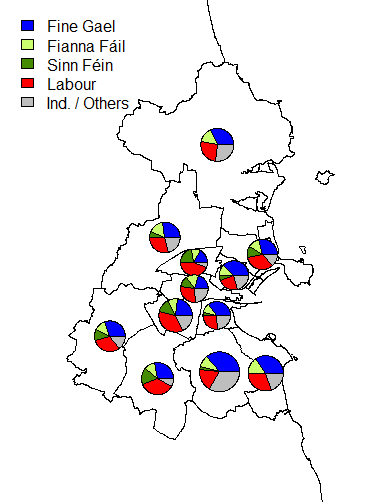
In the rest of Ireland, this trend was echoed, but not to the same extent:

Compared to vote share of 1st preferences:
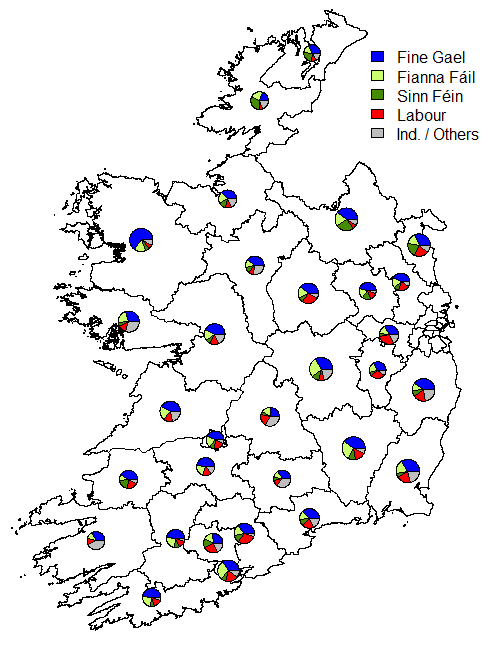
It will be interesting to see how this changes with the results over the weekend. The fragmentation of votes has been predicted by polls and media, but whether this will continue down to the vital second, third and fourth preferences will only reveal itself over the weekend.

 To be decided